 GrailstarBook a call
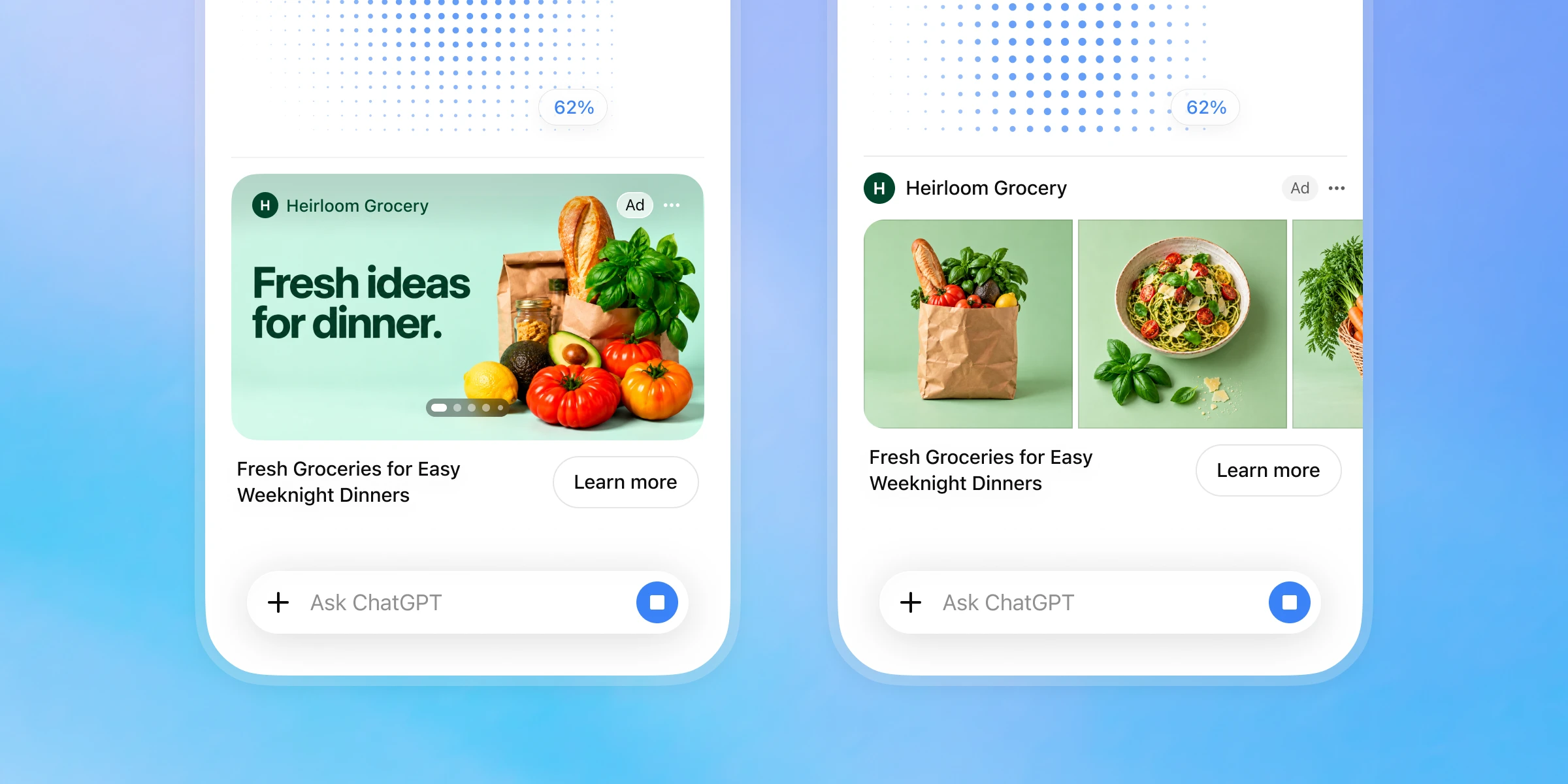
OpenAI plans to test visual ads during image generation in the US later in October 2026 with an initial group of advertisers. Ads stay labeled and separate from generated images and answers. Prepare accurate creative, a relevant landing page, and verified conversion tracking; measure paid performance separately from organic AEO/GEO visibility.
OpenAI's October 5, 2026 announcement introduces a visual direction for ChatGPT Ads and a broader measurement ecosystem. For marketing teams, the useful question is how to connect that opportunity to a clear offer, a relevant landing page, and evidence of business impact.
This guide separates the announced platform changes from Grailstar's practical recommendations. It is based on OpenAI's announcement, checked October 5, 2026.
What is the new ChatGPT visual ad format?
The format uses images to help people understand products, services, and the experiences they enable. OpenAI says the initial test will appear during image generation, with advertising clearly labeled and separate from the image being created. Ads do not influence ChatGPT's answers.
Testing is scheduled to begin later in October 2026 in the United States with an initial group of advertisers. That is a limited test announcement, not confirmation that every advertiser can use the format today. The announcement does not provide a universal launch date or a complete creative specification.
The supplied OpenAI example shows Heirloom Grocery product imagery and a Learn more destination. Treat it as an illustration of the announced format, rather than a Grailstar campaign or evidence of campaign results.
What changed in the October 2026 announcement?
| Update | What OpenAI announced | What to check before planning |
|---|---|---|
| Visual creative | An initial test during image generation | Account eligibility, timing, and current asset requirements |
| Conversion data | Integrations with Hightouch, Tealium, and LiveRamp | Which connection fits your existing data systems |
| Attribution | Web and app measurement partnerships | Supported events and reporting for your setup |
| Incrementality | Early work exploring geographic experiments | Whether a suitable test is available and feasible |
| Brand suitability | Negative Phrases for qualifying advertisers; DV and IAS evaluation pilots | Eligibility and the scope of available controls |
OpenAI's source announcement is the reference for these platform updates. Confirm the options available in your account before setting a launch date.
How should brands prepare their creative and landing pages?
Grailstar's recommendation is to start with one customer decision. Identify what someone is trying to accomplish, show a relevant product or service in use, and continue that same promise on the destination page.
A fictional meal-kit brand, for example, could build a concept around a quick weeknight dinner. Its destination should explain the meals, preparation time, delivery area, pricing, and next step. A beautiful image cannot resolve missing buying information.
Build a small preparation brief:
- Customer task: Write the decision in the customer's words.
- Offer: Name the product or service and its meaningful benefit.
- Visual evidence: Select accurate images that show the product, its use, or the resulting experience. Secure the necessary rights.
- Destination: Match the offer, answer likely questions, and make the next action clear on mobile.
- Measurement: Define the conversion and verify that it records correctly before spending.
- Review: Check eligibility, specifications, claims, and placement controls against the current account requirements.
These are preparation steps, not official creative specifications. Avoid designing an entire campaign around assumed aspect ratios, file limits, placement frequency, or targeting controls that OpenAI has not confirmed for your account.
How do attribution and incrementality differ?
Attribution assigns credit to an observed conversion. Incrementality estimates how many outcomes happened because of advertising. They answer different questions, so a report should label them separately.
An attributed purchase may have occurred after an ad interaction, but that alone does not prove the purchase would have disappeared without the ad. An experiment with a credible comparison can help estimate causal lift. It also needs enough data and a design appropriate to the business.
OpenAI lists attribution partners including AppsFlyer, Triple Whale, Adjust, DV Rockerbox, Northbeam, Branch, Singular, Kochava, Airbridge, and Tenjin. It also names Fospha, Measured, and INCRMNTAL for full-funnel and advanced measurement, and describes early geo-based experiment work with Haus, Measured, and WorkMagic. Those partnerships do not establish that every integration or experiment is available to every advertiser. See the measurement section of the announcement.
For a first measurement plan, record:
- The business outcome: a purchase, qualified lead, booked consultation, or another defined event.
- The event definition, reporting window, and handling of duplicate events.
- Spend, attributed outcomes, cost per outcome, and downstream lead quality or revenue.
- The measurement source and any missing data or reconciliation gaps.
- Experimental lift separately, when a valid experiment is actually available.
Use an existing measurement partner when it fits your business. Adding more dashboards is useful only if it resolves a decision or a data gap.
What do the early advertiser results tell us?
OpenAI reports three partner findings: WeightWatchers' attributed acquisition cost was 15.3% lower than its blended paid-search benchmark, according to DV Rockerbox; WorkMagic reported significant lift for Dose, with 67% of incremental purchases from net-new customers; and Triple Whale reported that 93% of Portland Leather's visitors from ChatGPT Ads were new.
These are different businesses, metrics, and measurement approaches. A new visitor is not the same as an incremental purchase, and attributed acquisition cost is not a universal return-on-ad-spend benchmark. The announcement does not establish that these findings came from the newly announced visual format.
Use the examples as reasons to investigate the channel with your own measurement plan. They are not Grailstar client results or predictions for your campaign. The figures are attributed in OpenAI's announcement.
What does this mean for AEO, GEO, and SEO?
ChatGPT Ads and organic AI visibility need separate plans. Paid placement can introduce an offer in an eligible advertising context. AEO and GEO work focuses on making your public information understandable, accurate, accessible, and useful when answer systems evaluate sources.
At Grailstar, AEO (answer engine optimization) describes improving information for answer-based discovery. GEO (generative engine optimization) focuses on visibility in generated answers. The terminology varies across the industry; neither is a mechanism for buying an organic recommendation.
The practical overlap is the website. Both an ad visitor and someone researching a cited page need clear product facts, credible evidence, relevant answers, and a useful next step. That makes landing-page quality a sensible shared investment, while paid conversions and organic citations remain separate measurements.
For Google's AI Overviews and AI Mode, Google Search Central says established SEO practices remain relevant and no special AI schema or additional optimization is required. Structured data should match the visible page; it does not guarantee inclusion.
For ChatGPT search discovery, OpenAI's crawler documentation recommends allowing OAI-SearchBot for search results. Search discovery and potential training controls are distinct. Access alone is not a promise of citation.
Start with our GEO content audit checklist and AI visibility measurement guide. Keep a dated record of prompts, answers, citations, and observed referrals alongside a separate paid campaign report.
What should brands know about suitability and privacy?
OpenAI says placement guardrails assess whether a conversation is appropriate for advertising. Its announcement describes Negative Phrases for qualifying advertisers and brand suitability evaluation pilots with DoubleVerify and Integral Ad Science.
The pilots use a controlled testing environment without accessing private user conversations. They are developing evaluations, not a claim that every brand has a completed independent certification or that advertisers can inspect people's chats.
For a campaign brief, document your brand's placement requirements and confirm the controls your account supports. Keep the creative, offer, and destination accurate even when the placement meets those requirements. See OpenAI's explanation of suitability safeguards.
A practical readiness checklist
Before treating the new format as a launch opportunity, bring these five pieces together:
- Confirmed access: Your account can use the intended format in the intended market.
- A focused offer: One customer task, truthful imagery, and a clear reason to consider the product.
- A useful destination: Mobile-readable details, evidence, buying questions, and a working conversion path.
- A tested measurement plan: Verified events, a defined outcome, and a reporting owner.
- Separate paid and organic reporting: Campaign results in one view; AI mentions, citations, and referrals in another.
If the format is not available to your account yet, finish the creative brief and improve the destination. That preparation remains useful when eligibility and specifications are confirmed.
Frequently asked questions
When will the new ChatGPT visual ads be available?
OpenAI says US testing will begin later in October 2026 with an initial group of advertisers. Its October 5 announcement does not confirm universal availability.
Will an ad appear inside the image ChatGPT creates?
OpenAI says the advertising will remain separate from the image being generated and will be clearly labeled.
Do ChatGPT Ads affect ChatGPT's answers?
No. OpenAI says advertising does not influence the answers ChatGPT provides. Buying an ad does not buy an organic recommendation.
Is this an AEO or GEO ranking update?
The announcement covers advertising formats, measurement, and brand suitability. It does not announce an organic ranking update. Keep paid campaign optimization separate from work on public content and AI-search discovery.
Can a business sign up for ChatGPT Ads now?
OpenAI directs businesses to ads.openai.com to sign up. Signing up is separate from being included in the initial visual-format test.
What should I measure first?
Choose one business outcome and verify its tracking. Report attributed results with their source and definitions, and describe incremental lift only when supported by a suitable experiment.
How can Grailstar help?
Grailstar helps brands plan ChatGPT Ads and AI visibility work, connect relevant creative to useful landing pages, and turn evidence into practical optimization decisions. Book a call to scope the creative, destination, and measurement work your business needs.
Sources and further reading
OpenAI: Building advertising for the way people use AI (October 5, 2026)Google Search Central: AI features and your websiteOpenAI: Web crawler controlsTALK IT THROUGH